How the Gordie Howe bridge became a symbol of a strained US-Canada relationship

 Bloomberg via Getty Images
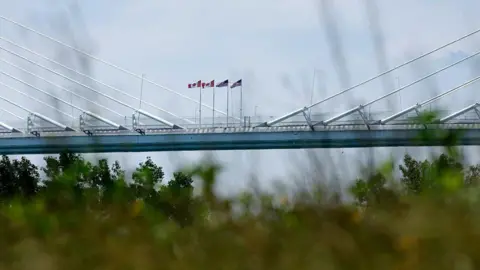
It was supposed to be a celebration marking the opening of a new international bridge connecting Detroit, Michigan and Windsor, Ontario, after eight years of construction and several delays.
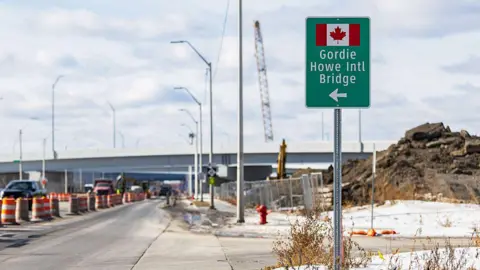
Canadian and American dignitaries planned to come together for the inauguration of the C$6.4bn ($4.5bn; £3.4bn) Gordie Howe International Bridge connecting the automotive hubs of each nation.
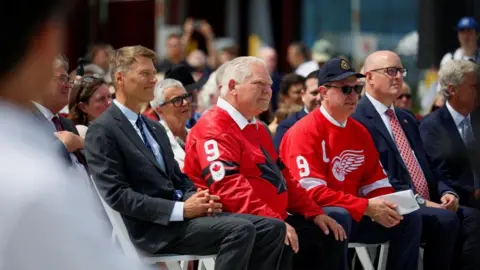
Instead, Canadians hosted their own event solo on Friday, having disinvited their US counterparts in the wake of Donald Trump's latest tariff threat on their country.
"Given the recent tariff action from the US, we felt that we should focus today on celebrating here in Canada," said infrastructure minister Gregor Robertson at Friday's event, which featured plenty of Canadian flags and a children's game of street hockey.
Earlier in the day, Trump acknowledged the snub by Canada in a social media post, saying it "is fine, considering they are paying substantial TARIFFS to the United States".
It's only the most recent bit of drama for a bridge meant to symbolise unity between the long-time allies and trading partners, named after a legendary Canadian ice hockey player who played the majority of his career for the Detroit Red Wings.
Now, it has come to reflect the fraught relationship between the two North American neighbours - and the pressure building on Prime Minister Mark Carney to navigate those choppy waters.
Almost 15 years ago, Canada agreed to fully pay for the bridge's construction to bypass US political resistance and get the project, seen as necessary infrastructure to fix a trade bottleneck, moving.
The bridge will help support more than C$1bn ($710m; £530m) worth of goods that pass through Windsor-Detroit crossing each day.
When Canada first took on the construction project, which will be owned by both Ottawa and Michigan, it agreed to share toll revenue with the US state only once its costs were paid.
Then, early this year, shortly before a planned ribbon-cutting ceremony, Trump said he would block its opening until Canada agreed to "share authority" and ownership.
"We should own, perhaps, at least one half of this asset," he said at the time.
The bridge has long faced pushback from the Moroun family in Michigan, who own the neighbouring Ambassador Bridge, the busiest commercial border crossing in North America and one of the few that are privately owned.
Billionaire Matthew Maroun, who is also a Trump donor, met with US Commerce Secretary Howard Lutnick hours before the president's comments, according to a New York Times report.
In June, Carney announced that Canada agreed to a US request to delay the opening of the bridge to allow for further negotiations.
Keen to get the vital trade link open, Ottawa accepted to now split half of the bridge revenues for the next 15 years with an economic development fund "solely controlled" by the US government.
Trump touted in a recent social media post the new agreement was "MUCH BETTER" for America.
The bridge fallout comes against a backdrop of a challenging trade dispute with Canada and the US. While he was running to be elected prime minister, Carney vowed to solve it with an "elbows up" approach - referencing a combative style of hockey coined by the late Gordie Howe himself.
Now Carney is facing pushback for conceding to a US administration that many Canadians view as treating their country unfairly.
"We're dealing with an administration like we've never seen before," Colin Robertson, a former Canadian diplomat and a fellow at the Canadian Global Affairs Institute, told the BBC.
"They renege on deals. They don't follow agreements. It's like dealing with pirates."
 Bloomberg via Getty Images
 Reuters
Canadian officials marked the bridge's opening on Friday
Canada has offered up a series of what the prime minister's critics have called concessions to the White House, including scrapping a digital services tax opposed by US tech companies and removing some retaliatory tariffs.
Conservative member of parliament Shuvaloy Majumdar said the whole scenario demonstrates that Canada has been negotiating "with weakness" as it tries to secure a broader trade deal with Trump.
"Canadians are sick and tired of being made into a punching bag by President Trump and have the self-respect to fight for their existence and their country," he said at a news conference. "They deserve a government that is willing to do the same thing."
Carney is also under scrutiny for a lack of clarity around the new bridge deal, and how revenues will be shared with the US.
On Thursday, he said the underlying agreement on recouping the toll revenues between Canada and the state of Michigan remains in place.
The new revenue sharing deal agreed with the White House is "in parallel" to that, he said.
Ontario Premier Doug Ford praised Carney for "an excellent job of getting this deal done".
Robertson said that, while what Carney agreed to is no doubt a "concession", it is a necessary one given the importance of the span to US-Canada commerce.
"This new state-of-the-art bridge was done at a great expense, and yes we paid, but it is necessary to keep supply chains intact," he said, adding that businesses and communities on both sides of the border have been pushing to get it open.
Watch: 'It's frustrating' Canadians react to the US tariffs
Some provincial leaders have pushed for firmer action on trade negotiations by Ottawa.
Premier Ford called Trump a "bully" and said Canada should consider using its energy and critical mineral exports as leverage in trade talks.
But others, like Alberta's Danielle Smith and Saskatchewan's Scott Moe, are urging restraint, revealing cracks in Canada's united approach to the US.
How Carney will respond is still anyone's guess. Robertson noted that while Gordie Howe played with his "elbows up", he would also say that "the objective is to get the puck in the net".
But Robertson added that he believes Canada has already given enough.
"Any further concessions would be problematic and probably not in our interest, given the behaviour of the Trump administration up to now," he said.