New Zealand’s two major parties are flatlining as dispirited voters seek transformational change
New Zealand voters sent the two major parties a clear message last night. They expect more.
In a resounding rejection of the incrementalist political managerialism that has characterised the governments led by the major parties over the past decades, seven in 10 voters passed over Labour, and the same number skipped National. Between them, the two parties took just over half the party vote, 58% on election night. It was the lowest combined major party vote ever.
Instead, a large proportion of the electorate shifted their party vote to the more transformationist minor parties, those with a clearer sense of purpose and vision for the country. Act and the Greens both recorded their best results ever. New Zealand First had its best since 2002. Te Pāti Māori held more seats than expected. Opportunity crossed the 5% threshold for the first time, to win seats in parliament, and may be a kingmaker come 27 November, when the count is finalised.
This was never going to be a definitive outcome or government decided on election night. For months the polls had predicted a razor-thin result that would ultimately depend on the count of the “special votes” cast mostly by people outside their electorate or overseas. That forecast was spot on. As was the prediction that the two major parties would be neck and neck. Labour gained 29.3% of the party votes and National 29.2%.
The major parties have no one to blame for this flatlining but themselves. Not only did their vision and policy offerings fail to fire, but for the past four years, two middle-aged men named Chris (Luxon the leader of National and Hipkins for Labour) have struggled to excite the electorate.
Both parties’ campaign strategies bombed. Luxon and Hipkins spent much of the campaign attacking each other while the real damage to their party numbers came from the minor parties on their own side of the political spectrum. Like the family in Judith Kerr’s The Tiger Who Came to Tea, Luxon and Hipkins held the door open and passively watched their guests raid the pantry.
Neither of the major parties will take comfort from the result. Labour improved by 2.2 points and two seats on 2023, but it was not enough to govern with the left bloc on the night. National fell 8.3 points, and the cost was brutal. Because National won more electorates than its party vote entitled it to, it gets no list seats at all. Senior figures who relied on the list are likely gone including the deputy leader and finance minister Nicola Willis, justice minister Paul Goldsmith, speaker of the house Gerry Brownlee, and high-ranking MP Chris Bishop.
They may have been abandoned by National’s party vote, but in a quirk of the MMP voting system, National was still able to retain more electorate seats than its share of the party vote, causing an overhang and giving the party more seats overall. Parliament normally has 120 seats, and a majority is 61. On election night the size of the house had grown to 131, with six overhang seats for National and five for Te Pāti Māori. That lifts the bar to 66. On election night the coalition cleared it with one seat to spare: National’s 42, plus 25 for ACT and NZ First.
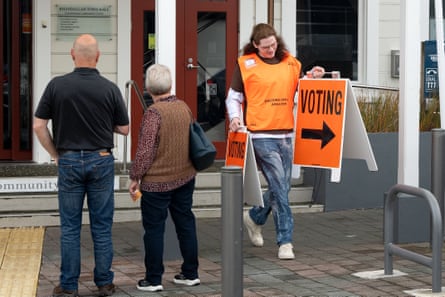
Voters outside Khandallah Town Hall on election day in Wellington, New Zealand. Photograph: Marty Melville/AFP/Getty Images
Several hundred thousand special votes are still to be counted. In 2017 and 2023 the specials cost National two seats. This time, with National in overhang, the specials are unlikely to cost National seats directly. But if Act or New Zealand First lose party vote percentage to the left or National loses a close electorate – like Wairarapa where its election night majority was only 139 – its one-seat margin is gone.
Luxon seemed to know it. When he eventually appeared to speak to the nation at midnight, he gave no victory speech, conceding that while National was still the largest party in parliament and had a pathway to forming the next government, the election was too close to call. Serious negotiations and compromises would wait for the final count on 27 November. Until then, the government continues in caretaker mode.
If the count holds, Luxon’s early decision to rule out working with Opportunity will have paid off, by a single seat. Whether by design or by luck, he will have avoided eating his words and calling Opportunity leader Qiulae Wong. But if the specials move even one seat, that call is back on the table.
Nor will a one-seat majority make governing easy. In a tight parliament, every government MP is a kingmaker. One backbencher with a grievance or a leadership grudge can hold the government to ransom. A single member defection could bring it down. So could a byelection, if an electorate MP dies, resigns or is caught in a scandal.
Luxon ruled out one kingmaker. Last night’s result may have handed him 67.
- Dr Claire Robinson is a political commentator and author of Promises, Promises: 80 Years of Wooing New Zealand Voters