US sending charter flight to bring Americans home from hantavirus cruise ship
15 hours ago

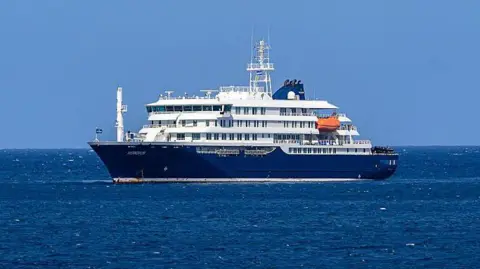 Getty Images
The US is sending a charter aircraft to bring home some Americans from a cruise ship where a hantavirus outbreak killed three people and infected several others, authorities say.
Officials say at least six US states are monitoring for possible cases after several passengers from the Dutch vessel MV Hondius returned home from the voyage.
The US Centers for Disease Control and Prevention (CDC) has classified the hantavirus outbreak as a "Level 3" emergency response, its lowest tier.
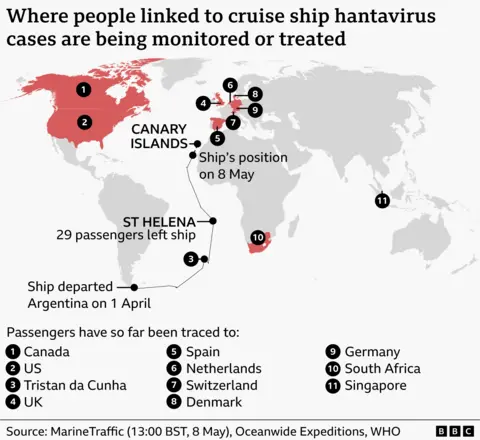
The luxury cruise, operated by Oceanwide Expeditions, departed from Ushuaia, Argentina, on 1 April and is due to arrive in Spain's Canary Islands in the early hours of Sunday.
The CDC is sending staff to the Canary Islands to escort American passengers home on a charter flight, the agency said on Friday.
Another team of health experts will travel to Nebraska, where the passengers are expected to quarantine.
"The US government's top priority is the safe repatriation of American passengers," the CDC said in a statement.
The passengers will be evacuated on a US government medical repatriation flight to an air force base in Omaha, Nebraska, where they could then be taken to isolate at the University of Nebraska Medical Center.
But in a briefing to US media on Saturday, CDC officials disputed that the patients would be kept in quarantine.
"We are not quarantining anybody," a CDC official told reporters, speaking on condition of anonymity, according to ABC News.
On the call, the official also said the group would not be tested, because "it is not recommended to test people that do not have symptoms", the network reported.
The officials also said the passengers would be monitored for 42 days, and that once they returned home, local health departments would monitor them "at least daily".
Acting CDC Director Jay Bhattacharya explained the process to Fox News on Saturday.
"What it'll be is self-isolation," he said. "None of these folks have any symptoms at all. We're going to have them isolate for about 42 days."
There are 17 Americans on board the cruise ship, according to its operator, Oceanwide Expeditions.
At least seven passengers from the same cruise ship have already returned to the US.
State health departments are monitoring them for possible infections: two in Georgia, two in Texas, one in Virginia, one in Arizona and an unspecified number in California.
Oceanwide Expeditions said six Americans and more than two dozen other passengers disembarked in St Helena, a British territory, on 24 April.
Officials have confirmed five of the eight suspected hantavirus cases linked to the outbreak.
New Jersey Governor Mikie Sherrill said on Friday that two state residents may have been exposed during a flight with a passenger infected with hantavirus after leaving the cruise.
When the outbreak began, the CDC said the risk to the wider American public remained low.
"The Department of State is leading a coordinated, whole-of-government response including direct contact with passengers, diplomatic coordination, and engagement with domestic and international health authorities," the CDC said.
The CDC did not respond to a BBC question about whether it had established a dedicated outbreak response team.
President Donald Trump said on Thursday the outbreak was "very much, we hope, under control", and that his administration would provide a "full report" on it on Friday.
[
How worried should we be about hantavirus?
](https://www.bbc.com/news/articles/c98r199e195o)
Officials have not yet confirmed how the outbreak began, but hantavirus is typically spread by rodents. People can become infected by breathing in air contaminated with virus particles from rodent urine, droppings or saliva.
The World Health Organization says the current outbreak is unlikely to become a pandemic like Covid-19 because this strain of hantavirus spreads through "close, intimate contact".
But the WHO warned that more cases could emerge because the disease has an incubation period of up to six weeks.