Voyager 1 reaches a milestone nearly 50 years in the making: One light-day from Earth
Nearly five decades after leaving Earth, NASA's Voyager 1 has traveled so far that radios signal take an entire day to reach it and it to reach back out to Earth. No human-made object has ever been this far away.
© NASA/JPL
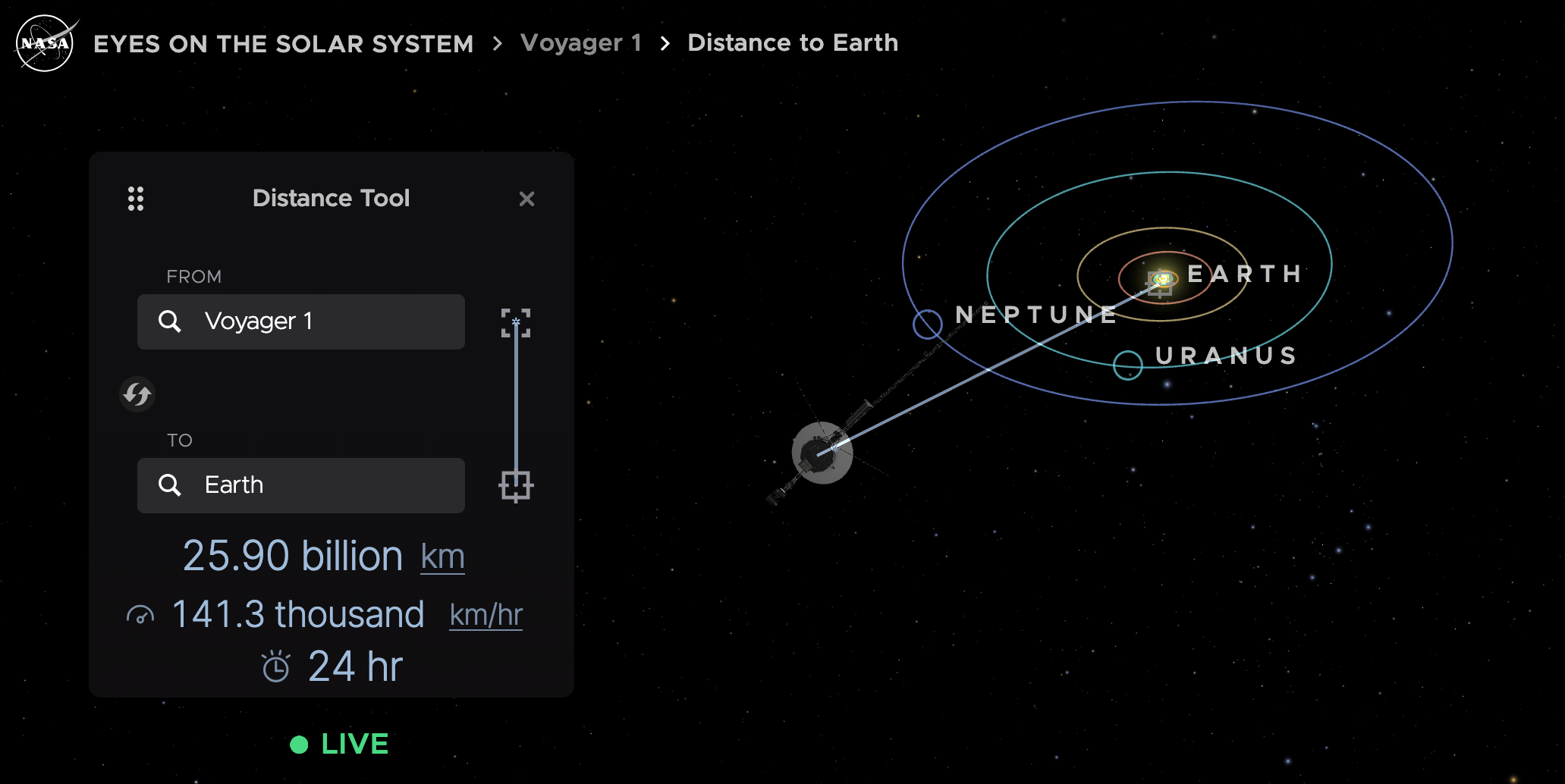
It crossed the one-light-day milestone.Wednesday morning, November 18, becoming the first human-made object to travel that far from Earth. At 5:16 a.m. Eastern time, the spacecraft passed a distance of 16.094 billion miles, or 25.902 billion kilometers. A light-day is the distance light travels in 24 hours. At approximately 186,000 miles per second, that works out to more than 16 billion miles.
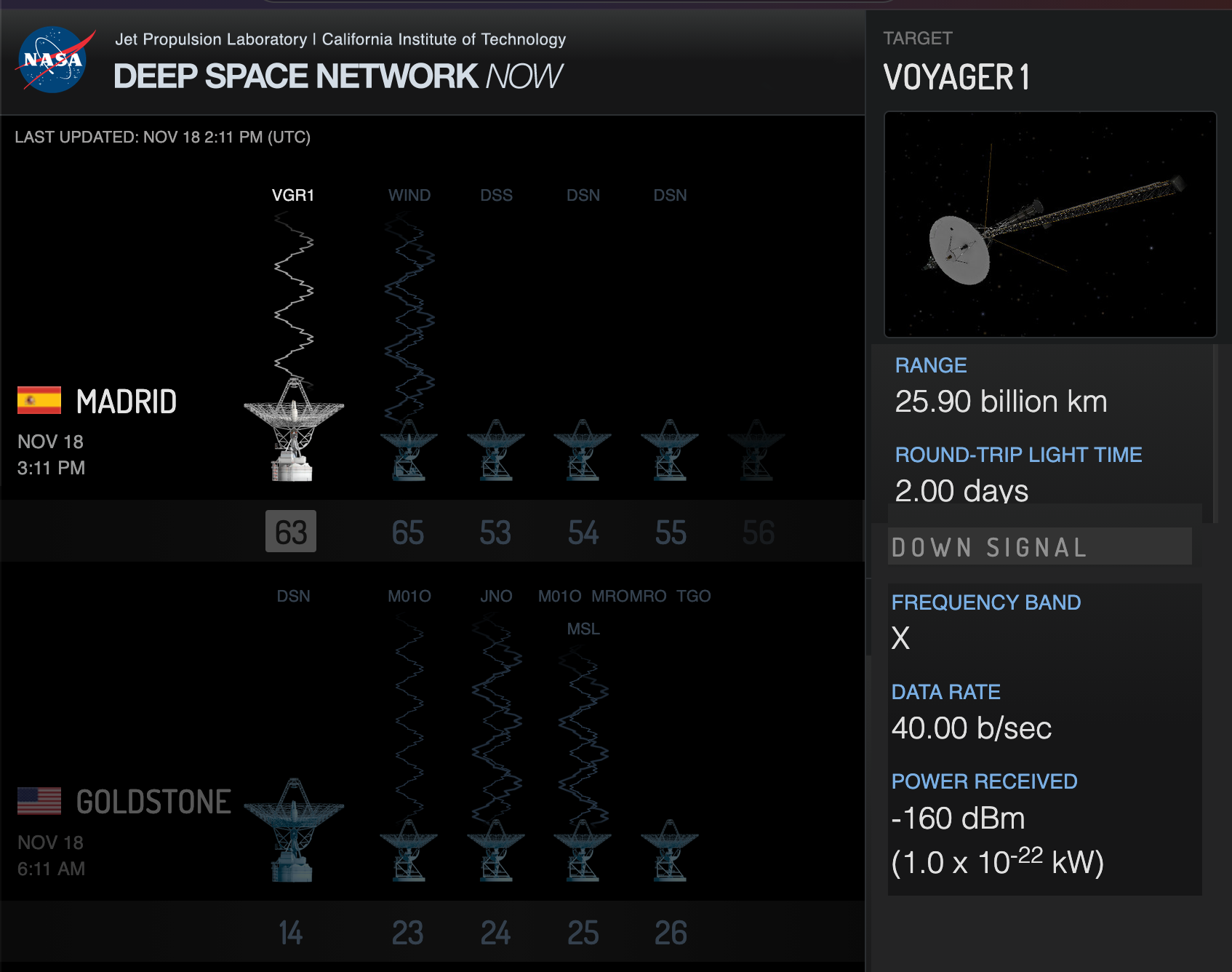
You can check in on Voyager and nearly 4 dozen other missions on NASA's Deep Space Network at eyes.nasa.gov (© Credit: NASA/JPL)
A signal weaker than you can imagine
Getting data back to Earth from a light day away is engineering accomplishment in itself. By the time Voyager's radio signal reaches Earth, its power has faded to approximately -160 dBm, or about 100 attowatts. An attowatt is one quintillionth of a watt.
For comparison, the Bluetooth transmitter in a phone can transmit at about 2.5 milliwatts. The power of Voyager's received signal is about 25 quadrillion times smaller.
The signal strength isn't the only challenge. Voyager's data rate is remarkably slow by modern standards.
Voyager sends around 40 bytes per second, a big reason why the Voyagers show up so frequently on the Deep Space Network it takes a while to download data. To put that in perspective, this article, including the text, images other page elements would take more than 4.5 days of continuous transmission, plus the day for the signal to make it to Earth
Running on borrowed time
After nearly 50 years in space, Voyager 1 is operating well beyond its original design life. Its electrical power comes from radioisotope thermoelectric generators (RTG), which convert heat produced by the natural radioactive decay of plutonium-238 into electricity.
That power supply steadily weakens over time. NASA engineers have been shutting down instruments and other systems to conserve electricity and extend the spacecraft's working life.
Despite those challenges, Voyager 1 continues to send scientific data back to Earth. Keeping the spacecraft operating requires careful management of its limited electrical power and the aging hardware aboard a probe that cannot be repaired or serviced.
-
The magnetometer measures the strength and direction of magnetic fields in interstellar space. Scientists use those measurements to understand how the Sun's magnetic influence extends into the surrounding galaxy.
-
The Plasma Wave Subsystem detects oscillations in electrically charged gas, or plasma. Those measurements help scientists study the density and behavior of the interstellar medium, including vibrations in the gas surrounding the spacecraft.
© NASA
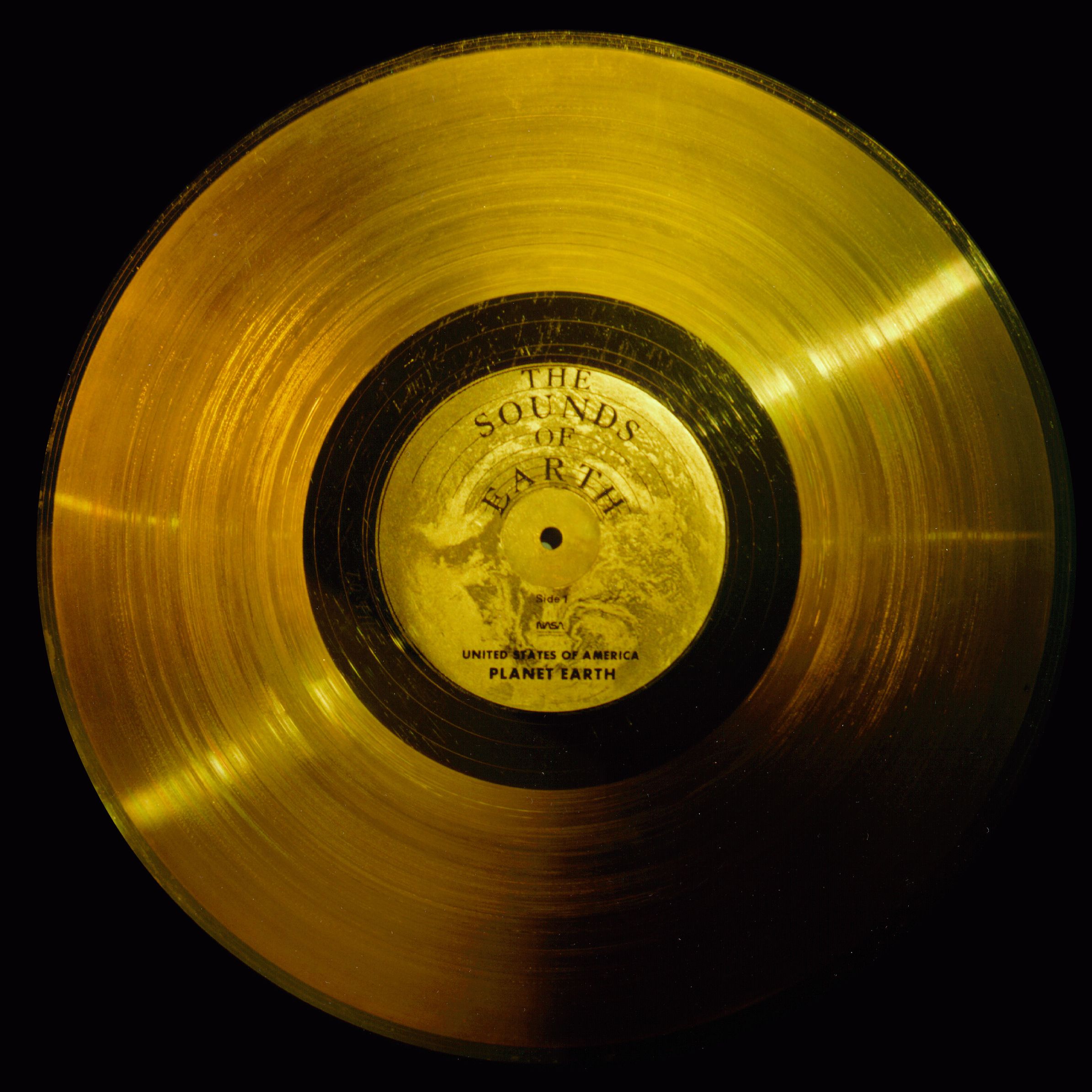
Voyager 1 also carries one of the more unusual payloads ever sent into space: a golden record. Janet Sternberg, a grad student at Cornell University where Carl Sagan collected sounds, music, greetings in dozens of languages and images intended to represent life on Earth, spoke to WRAL in 2013 about her experiences recording the Portuguese greeting.
Sternberg spoke with WRAL about her experiences recording the message to any extraterrestrial civilization that might eventually encounter the spacecraft. It includes instructions for playing the record and information about the location of our solar system.
A copy of the golden record is on display at the Smithsonian's National Air and Space Museum, in Washington, DC. The images, music, sounds and greetings are also available on NASA's voyager website.
Voyager 1 is headed generally toward the star Gliese 445, currently about 17 light-years from Earth. At its present speed, it will take roughly 40,000 years to pass within about 1.7 light-years of that star.
For now, Voyager 1 continues its journey at approximately 38,000 miles per hour but more importantly continues its mission to measure particles, magnetic fields and other conditions in the space between stars (Interstellar space is not as empty as the movies make it out to be).
You can check in on Voyager 1, its sister Voyager 2 and nearly 4 dozen other NASA and international partner missions communicating through NASA's Deep Space Network